
Sanctions in a Snap: Developments in Sanctions February 2026
A summary of recent developments from OFAC.
Hughes Hubbard's "Sanctions in a Snap" is intended to provide a clear and concise summary of recent developments from the Office of Foreign Assets Control (OFAC). We hope you find it helpful in assessing U.S. economic sanctions compliance risk against current U.S. government designation and enforcement priorities.
Highlights from February include:
The largest civil monetary penalty assessed against an individual (continuing the recent trend of increasingly significant enforcement responses against individuals)
The first civil monetary penalty assessed against an academic institution unrelated to Cuba travel
Designations of government officials that signal upcoming significant economic pressure against Nicaragua
In total, OFAC added 82 individuals and entities to its Specially Designated Nationals and Blocked Persons List and identified 28 vessels as blocked property.
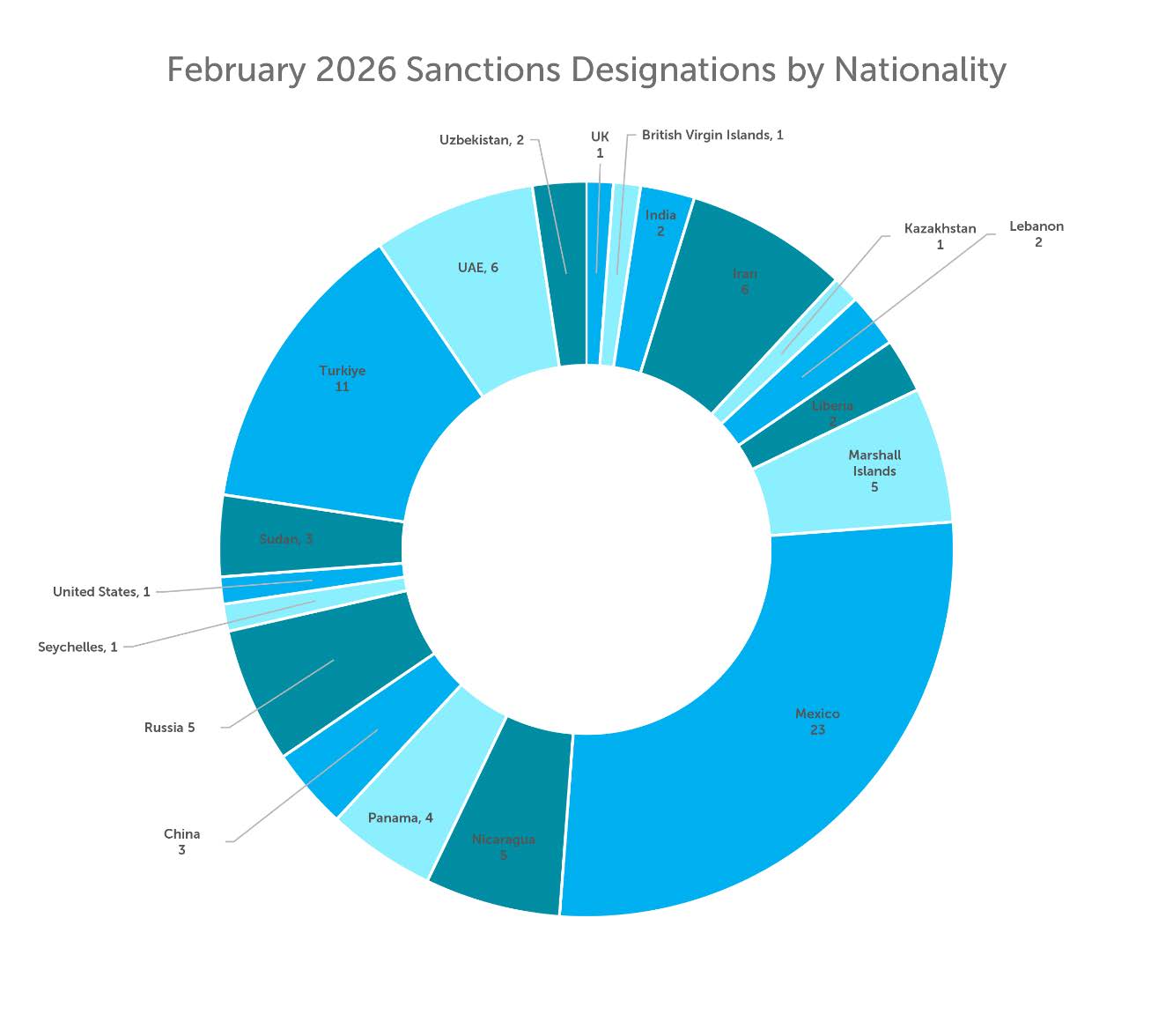
The February sanctions designations focus on Mexico and Iran - 75% of the February designations involve alleged Mexican cartel affiliates or the Iranian oil and petrochemical sectors. Those actions reflect a continuation of the second Trump administration's national security and foreign policy prioritization.
The graph at the end of this update provides a visual representation of the current targeting priorities reflected in the February designations.
$3.8M Civil Monetary Penalty Against a US Person
On Feb. 25, OFAC announced a $3,777,000 settlement with a U.S. person to resolve potential civil liability arising from apparent violations of the Syrian Sanctions Regulations. According to OFAC, between 2018 and 2021, the U.S. person allegedly violated the then-comprehensive sanctions against Syria by providing executive and board member services to four Syrian real estate companies.
OFAC found that the apparent violations were egregious and not voluntarily self-disclosed. Based on those findings, OFAC assessed the base penalty equivalent to the statutory maximum amount of $7,554,000.
OFAC reduced the base penalty because of the individual's "lack of sanctions history" (no OFAC Penalty Notice or Finding of Violation in the past five years) and cooperation through tolling the applicable statute of limitations.
Root cause of the violations: Failure of the individual to understand that status as a U.S. person (first as a lawful permanent resident and then as a naturalized citizen) means the Syria-related services were prohibited as a matter of law, even in the absence of any other connections to the United States.
$1.7M Civil Monetary Penalty Against a US Academic and Sports Training Institution
On Feb. 12, OFAC announced a $1,720,000 settlement with IMG Academy LLC, a Florida-based school and athletic training facility, to resolve potential civil liability arising from apparent violations of the Foreign Narcotics Kingpin Sanctions Regulations. According to OFAC, between 2018 and 2022, IMG Academy allegedly engaged in 89 apparent violations of the Foreign Narcotics Kingpin Sanctions Regulations by transacting with two sanctioned individuals involving tuition and other payment obligations.
OFAC found that the apparent violations were not voluntarily self-disclosed and non-egregious. Based on those findings, OFAC assessed the base penalty equivalent to the applicable schedule amount, which in this case totals the settlement amount of $1,720,000.
OFAC did not adjust the base penalty because it determined that the aggravating and mitigating enforcement factors offset each other. Importantly, IMG Academy was not granted credit for voluntarily self-disclosing the apparent violations, even though the school contacted OFAC immediately upon discovery of the same, because the agency had already begun an investigation at that time.
Root cause of the violations: Failure to implement minimal controls to screen payer or contracting party identifiers obtained in the ordinary course of business.
Probable Upcoming Sanctions Targeting the Nicaraguan Gold Sector
On Feb. 26, OFAC announced the designations of five Nicaraguan government officials for allegedly “enabling the Murillo-Ortega dictatorship’s repression.” Those actions represent the first Nicaragua related sanctions imposed during the second Trump administration. In the announcement, Treasury Department Secretary Scott Bessent claimed that the U.S. government “will continue to hold the dictatorship to account and to amplify the Nicaraguan people’s aspirations for freedom and justice.”
Notably, the U.S. government may extend the current list-based Nicaragua-related sanctions prohibitions to quasi-comprehensive sanctions measures. For example, Executive Order 13851, as amended, authorizes prohibitions on (1) imports of Nicaraguan-origin products into the United States; (2) the sale, supply or export from the United States to Nicaragua; and (3) new investment in Nicaragua. Additionally, OFAC is currently authorized to impose sanctions against any individual or entity determined “to operate or have operated in the gold sector of the Nicaraguan economy[.]”
The U.S. government likely perceives the Nicaraguan gold sector as an economic pressure point. Probable future sanctions targeting Nicaragua will relate to the General Directorate of Mines, a Nicaraguan government entity described by OFAC in 2022 as “an important piece of state-controlled gold operations in Nicaragua.”
Additional Sanctions Actions in February:
In addition to the OFAC actions summarized above, the U.S. government announced the following in February:
Designations (additions to the Specially Designated Nationals and Consolidated Sanctions Lists):
Feb. 6 – Fifteen entities predominantly based in China, Türkiye and the United Arab Emirates, as well as one Turkish individual and one lndian individual, for alleged involvement with Iranian crude oil, petroleum products and petrochemical products. The State Department concurrently identified 14 vessels as blocked property of those sanctioned entities.
Feb. 10 – One Russian individual, one Lebanese individual and four entities based in Panama, Lebanon and Türkiye for alleged support of sanctions evasion schemes involving Hezbollah financial institution Al-Qard Al-Hassan and an additional Iranbased Hezbollah finance operation.
Feb. 19 – Three Sudanese individuals who allegedly act as commanders of the Rapid Support Forces, a Sudanese paramilitary group.
Feb. 19 – A Mexican timeshare resort, along with five Mexican individuals and 17 Mexican companies. The individuals and companies are alleged to have supported a timeshare fraud scheme based at Kovay Gardens, allegedly led by the terrorist network Cartel de Jalisco Nueva Generacion.
Feb. 24 – Russian national Sergey Sergeyevich Zelenyuk and his cyber tools company, Matrix LLC (doing business as Operation Zero), along with three Russian individuals and two entities allegedly associated with Zelenyuk. The individuals and entities were designated under the Cyber-Related Sanctions program and the Protecting American Intellectual Property Act for the alleged theft of trade secrets from U.S. persons.
Feb. 25 – Four Iranian individuals and 16 entities based predominantly in Iran, Türkiye and Panama for allegedly operating in the petroleum and/or petrochemical sectors of Iran or involvement in Iran’s weapons programs. OFAC identified 12 vessels as blocked property of those designees.
Sanctions list removals
Feb. 27 – OFAC removed sanctions imposed against four individuals: one Lebanese individual previously sanctioned under the Lebanon-related sanctions program related to corruption allegations and three Malian individuals previously sanctioned pursuant to the Russia-related sanctions program for alleged links to the Wagner Group.
General licenses
Venezuela-related General License SU (Feb. 2), “Authorizing Certain Transactions Related to the Petróleos de Venezuela, S.A. 2020 8.5 Percent Bond on or After March 20, 2026”
Venezuela General License 48 (Feb. 10), “Authorizing the Supply of Certain Items and Services to Venezuela”
Venezuela General License 30B (Feb. 10), “Authorizing Certain Transactions Necessary to Port and Airport Operations”
Venezuela General License 46A (Feb. 10), “Authorizing Certain Activities Involving Venezuelan-Origin Oil”
Venezuela General License 49 (Feb. 13), “Authorizing Negotiations of and Entry into Contingent Contracts for Certain lnvestment in Venezuela”
Venezuela-related General License 50 (Feb. 13), “Authorizing Transactions Related to Oil or Gas Sector Operations in Venezuela of Certain Entities”; OFAC later amended this license on Feb. 18
Counter Terrorism General License 34 (Feb. 19), “Authorizing the Wind Down of Transactions lnvolving Kovay Gardens”
Russia-related General License 131C (Feb. 26), “Authorizing Certain Transactions for the Negotiation of and Entry Into Contingent Contracts for the Sale of Lukoil International GmbH and Related Maintenance Activities”
Please see our comments on this general license and Lukoil’s tentative agreement to sell certain overseas assets to U.S.-based investment firm Carlyle published by Energy Intelligence.
Regulations and Guidance
Frequently Asked Questions
OFAC amended Venezuela-related FAQ 595 on Feb. 2 to reflect the effective date delay of General License 5, which will authorize certain transactions related to the PdVSA 8.5 Percent Bond on March 20.
On Feb. 6, OFAC issued 10 Venezuela-related FAQ, FAQ 1126-1235, to provide guidance and clarification regarding the scope of Venezuela General License 46, which authorizes certain activities involving Venezuelan-origin oil.
OFAC issued FAQ 1236 and 1237 on Feb. 18 to provide guidance and clarification regarding the scope of Venezuela-related General License 30B (port and airport operations), General License 46A (Venezuelan-origin oil) and General License 48 (items and services to Venezuela).
On Feb. 25, OFAC issued FAQ 1238, which publicly establishes a favorable licensing policy for certain resale of Venezuelan-origin oil to Cuba.
On Feb. 26, OFAC amended Russia-related FAQ 1224 and 1225 relating to the authorizations for certain maintenance, wind down and negotiations involving Lukoil International GmbH.
Miscellaneous
Voluntary Self-Disclosure Portal
OFAC launched an online Voluntary Self-Disclosure Portal on Feb. 6 "to improve customer service" and "provide[] a streamlined, secure method for submitting voluntary self-disclosures of potential violations of OFAC administered sanctions programs."
U.S. Targeting Priorities
Featured Lawyers

Sanctions in a Snap: Developments in Sanctions
Hughes Hubbard’s “Sanctions in a Snap” provides a clear and concise summary of recent developments from the United States' Office of Foreign Assets Control (OFAC) and the European Union and its Member States.

Stay Up to Date
Sign up to receive practical updates, fresh perspectives and helpful guidance delivered straight to your inbox.
Stay connected for our latest news and insights.